
You sat through the consultation and listened to the treatment plan. You were ready to move forward with dental implants, but then your dentist said something like, “We’ll refer you to an oral surgeon for the surgical part.”
Maybe you nodded and took the referral slip. You didn’t think much of it then, but later, a question started nagging at you: why can’t one office just handle this? It’s a fair question, and the answer says a lot about how implant treatment works in most dental practices, why the referral model exists, and what it actually means for your care when a practice decides to do things differently.
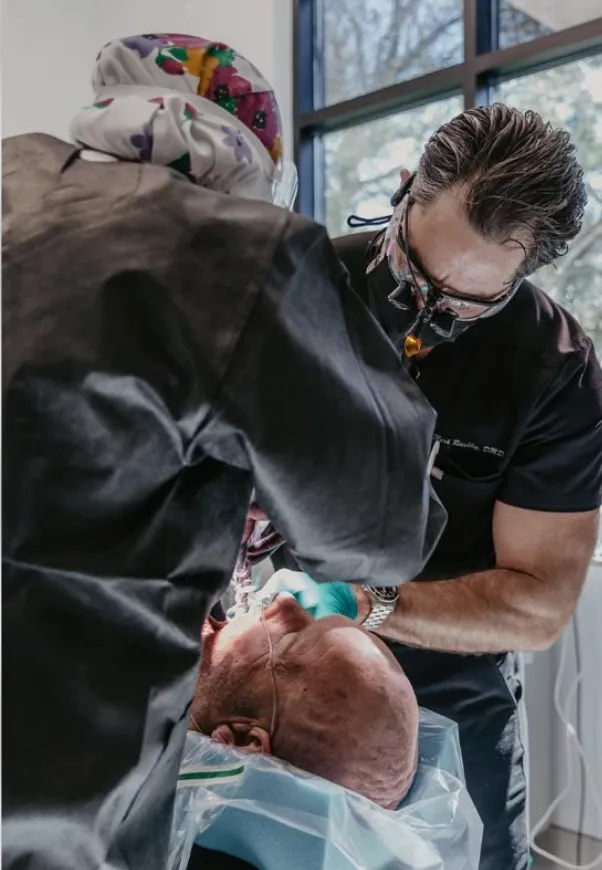
At Coastal Cosmetic & Implant Dentistry, we don’t send you to another office for implant surgery. Dr. Mark Reichley handles the surgical placement right here in our Virginia Beach office, and Dr. Cappy Sinclair plans the final restoration alongside him. Before we explain why that matters, let’s talk about why the referral model is so common.
Why Most Dentists Refer You Out for Implant Surgery
Well, most general dentists don’t place dental implants. They restore them, which means they design and fit the crown, bridge, or denture that sits on top of the implant. For the surgical part, where the titanium post goes into your jawbone, they refer you to a specialist.
A few reasons exist for this, including:
- Training: Placing implants requires surgical education that goes beyond what most dental schools cover. Oral surgeons complete four to six additional years of hospital-based residency after dental school, including anesthesia training. They train for complex surgical cases, and many general dentists don’t have that background.
- Liability and Comfort: Surgery carries risk. Even straightforward implant placement involves cutting into bone, managing soft tissue, and watching for complications. Some dentists prefer to hand that off.
- Logistics: Placing implants requires specific equipment, surgical suites, and sedation protocols that a typical general dental office isn’t set up for.
So the referral happens. You’re sent to an oral surgeon’s office and fill out new-patient paperwork. You get new X-rays because the surgeon’s office can’t access your dentist’s records. The surgeon places the implant, you heal for a few months, and then you go back to your original dentist for the crown. On paper, it sounds organized. In practice, it creates friction for patients.
What Actually Gets Lost in the Handoff
When two separate practices handle your care, information gets dropped. Not because anyone is careless, but because the systems aren’t built to talk to each other the way a single team’s workflow is.
Think about what it takes to place an implant well. The surgeon needs to know where the final crown will sit, what angle it needs to face, and how much space the restoration will occupy. That planning has to happen before the implant goes in. If the surgeon and the restorative dentist aren’t communicating in real time, with shared records and shared imaging, details get missed.
You might end up with an implant that’s perfectly healthy but positioned in a way that makes the final crown look slightly off. Or you might need extra appointments to redo impressions because the surgeon’s records don’t match your dentist’s system. Or you might hear one thing from one office and something different from the other, leaving you trying to figure out who’s right.
There’s also the emotional friction. If something feels wrong after surgery, who do you call? The surgeon’s office says it’s a restorative issue. The restorative office says it’s a surgical issue. You’re stuck in the middle, making phone calls, repeating yourself, waiting for someone to take ownership.
None of this is catastrophic, but it adds up. For patients who are already nervous about implants, that added friction can be enough to make them postpone treatment or give up entirely.
What “Under One Roof” Actually Changes
When a practice handles every phase of implant treatment in the same office, with the same team, the handoffs disappear.
At our Virginia Beach office, that’s exactly how it works. Your consultation, imaging, surgical planning, implant placement, temporary teeth, post-op checkups, and final restoration all happen here. Your records stay in one place. The people who plan your case are the people who execute it.
This matters more than you’d think. For one thing, the planning is better. Dr. Reichley places the implant with the final restoration already designed. He knows exactly where the crown needs to sit because Dr. Sinclair has planned it. The implant is placed where it needs to be for the best long-term result.
The timeline is also shorter. You don’t have to wait for records to transfer or schedule separate consultations with different offices. You don’t have to repeat your story to someone who doesn’t know your case. Everything happens on one schedule, with one team.
When something feels off after surgery, you call one number. You talk to people who know your case, have your records, and can actually do something about it. There’s no finger-pointing, no “that’s not our department.”
Why Dr. Reichley’s Credentials Matter Here
Not every dentist who places implants has the training to handle complex cases. Dr. Reichley does.
He earned his DMD from the University of Pennsylvania School of Dental Medicine, an Ivy League institution. He served four years as a dental officer in the U.S. Navy, including two humanitarian deployments. He’s completed advanced post-graduate training at the Kois Center in Seattle, the Nobel Institute in Los Angeles, and the Pikos Institute outside Tampa. And he holds Fellowship status in the International Congress of Oral Implantologists, a credential that requires demonstrated proficiency and excellence in implant surgery.
That matters for patients in Virginia Beach because it means you won’t be referred to a stranger. You’re getting a highly trained surgeon who works alongside a cosmetic dentist with AACD accreditation and plans and executes your case as part of the same team.
If you’ve been told you need a bone graft, or if your case is complex, or if you’ve been missing teeth for a long time and have significant bone loss, that level of training isn’t a luxury. It’s the difference between a plan that works and a plan that gets revised halfway through.
Questions to Ask Before You Accept a Referral
If your current Virginia Beach dentist refers you to an oral surgeon for implants, you don’t have to accept that as the only path. You’re allowed to ask questions:
- Ask who will plan the final restoration.
- Ask whether the surgeon and the restorative dentist will communicate directly about placement angle and position.
- Ask what happens if something goes wrong after surgery, and who you should call.
- Ask whether the surgeon has Fellowship training or board certification in implant surgery, or whether they’re a generalist who places implants occasionally.
- Ask yourself whether you want to be the person carrying information between two offices, or whether you’d rather have one team that owns your outcome from start to finish.
At Coastal Cosmetic & Implant Dentistry, we think the answer to that last question is obvious. If you’re considering implants in Virginia Beach and you want a team that handles everything in one place, we’d love to talk. Call us at 757-656-6368 or request an appointment online. We’ll walk you through your options and show you what a one-roof approach actually feels like.
Learn more about our implant services:
- Teeth-In-A-Day
- All-On-Four Implants
- Benefits of All-On-Four Implants
- Cost of Dental Implants
- Dental Implants Under One Roof
- Dental Implants vs Dentures
- Multiple Dental Implants
- Dental Implant FAQs
- All-On-Four Dental Implants Suffolk, VA
- Dental Implants Chesapeake, VA
- All-on-4 Dental Implants Norfolk, VA
- All-On-Four Dental Implants Chesapeake, VA
- Dental Implants Norfolk, VA