
If you’ve been told you need a bone graft before getting dental implants in Virginia Beach, you probably have questions. Is this really necessary? Is it just an add-on cost? Can I skip it? What happens if I do?
These are fair questions. Bone grafting is one of the most misunderstood parts of implant treatment. Some patients need it, but many don’t. The difference comes down to what’s happening in your jaw, something your dentist can see on imaging but you can’t see in the mirror.
Let’s break down when bone grafting is genuinely necessary, and when you can reasonably skip it.
What a Bone Graft Actually Does
A dental implant works like a replacement tooth root. It sits in your jawbone, and over a few months, your bone fuses to the implant surface through osseointegration. That fusion is what makes implants stable enough to chew on.
However, if there isn’t enough bone where the implant needs to go, the implant won’t have a solid foundation. It might not integrate properly or could fail completely. The dentist may need to place it at an angle that compromises the final restoration.
A bone graft adds volume to the jaw. The graft material, which can come from a donor, your own body, or synthetic sources, creates a scaffold your body uses to grow new bone. Over time, your body replaces the graft material with its own bone tissue. The goal is to create enough stable bone in the right location for the implant to succeed.
When You Genuinely Need a Bone Graft
You need a graft when the bone in the planned implant site isn’t sufficient to support an implant. That insufficiency can come from several places:
- You Lost the Tooth a While Ago: After you remove a tooth, the bone that supported it starts to shrink. This happens relatively quickly, within the first few months, and continues over time. If you’ve been missing a tooth for a year or more, you’ve likely lost some bone volume.
- You’ve Had Gum Disease: Periodontal disease doesn’t just affect your gums. It erodes the bone that holds your teeth in place. If you’ve lost teeth to gum disease, the bone in that area is likely compromised.
- The Tooth Was Infected: Infections around a tooth can damage the surrounding bone. Even after you remove the tooth, you may need to rebuild the bone before you can place an implant.
- You’ve Worn Dentures for a Long Time: Traditional dentures rest on your gums, not your bone. Without the stimulation of chewing on tooth roots, the jawbone under a denture gradually shrinks. This is why long-term denture wearers often need grafting before implants.
- Your Anatomy is Naturally Thin in that Area: Some people have less bone in certain parts of the jaw, especially the upper jaw near the sinuses.
When Dr. Reichley evaluates a patient for implants, he uses 3D imaging to measure bone volume and density exactly where the implant would go. He measures your jaw’s dimensions and compares them to the implant’s requirements.
When You Can Skip the Graft
Many patients don’t need a bone graft. If the tooth was recently removed and the bone hasn’t had time to shrink, you may have plenty of bone for an implant. If your bone density is good and the site is healthy, you may not need grafting. Sometimes you can place an implant at the same time as the extraction, so it’s one procedure instead of two.
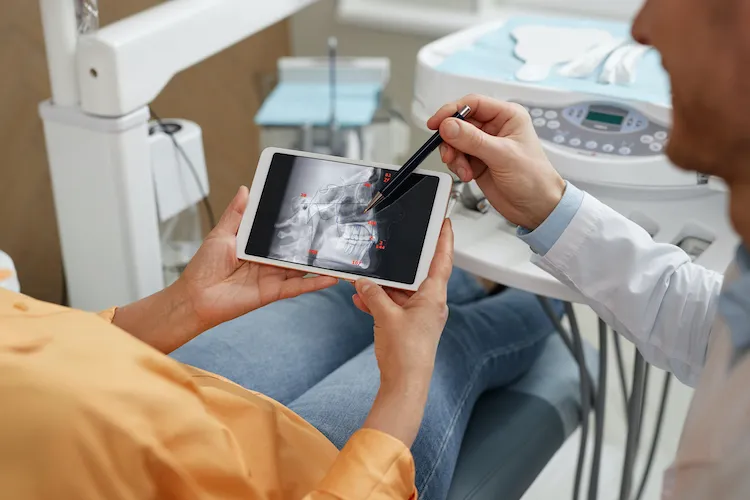
The only way to know for sure is imaging. A 2D X-ray provides some information, but a 3D scan gives a much clearer picture of bone volume and density, as well as the location of nearby structures like nerves and sinuses. At our Virginia Beach office, we use 3D imaging for every implant evaluation because it turns a guess into a plan.
If another provider tells you you need a graft, it’s reasonable to ask for the imaging behind that recommendation. A good dentist will show you what they’re seeing and explain why you need a graft. If they can’t or won’t, that’s worth paying attention to.
What to Ask Before You Agree to a Graft
If grafting comes up in your treatment plan, ask a few questions:
- What type of graft is this? Is it socket preservation, which fills the hole after an extraction to prevent bone loss? Is it a ridge augmentation, which rebuilds bone width? Or is it a sinus lift, which adds bone height in the upper jaw? Each serves a different purpose, and costs and healing times vary.
- How much bone do I actually have, and how much will the graft add? Ask to see the imaging. A good dentist will walk you through it.
- Can the graft and the implant be done at the same time, or do I need to heal first? Sometimes they can be combined. Sometimes the graft needs time to integrate before the dentist places the implant. The answer depends on your specific situation.
- What happens if I don’t do the graft? This is a fair question. Sometimes the implant can’t be placed safely. Sometimes the implant can be placed, but with a higher risk of complications. You deserve to know the trade-offs.
At Coastal Cosmetic & Implant Dentistry, Dr. Reichley includes bone-grafting analysis in the implant-planning process. He’s a Fellow of the International Congress of Oral Implantologists, trained to evaluate complex cases and make grafting decisions based on imaging, not guesswork. If you’ve been told you need a graft, or if you’ve been told you’re not a candidate for implants because of bone loss, we can take a look and give you a clear answer.
Call our Virginia Beach implant dentistry at 757-656-6368 or request an appointment online. We’ll show you what’s actually happening in your jaw and explain your options in plain language.
Learn more about our implant services:
- Teeth-In-A-Day
- All-On-Four Implants
- Benefits of All-On-Four Implants
- Cost of Dental Implants
- Dental Implants Under One Roof
- Dental Implants vs Dentures
- Multiple Dental Implants
- Dental Implant FAQs
- All-On-Four Dental Implants Suffolk, VA
- Dental Implants Chesapeake, VA
- All-on-4 Dental Implants Norfolk, VA
- All-On-Four Dental Implants Chesapeake, VA
- Dental Implants Norfolk, VA