
When patients hear “multiple implants,” they picture one implant per missing tooth. They think if you’re missing four teeth, you need four implants. If you’re missing six, you need six. That’s not how it works! Understanding why can save you thousands of dollars and months of unnecessary treatment.
Dental implants aren’t placed one-for-one with missing teeth. We place them strategically to support a restoration, such as a bridge, a partial, or a full arch of teeth. Two implants can support three teeth. Three implants can support five. Four implants can support an entire arch.
The right configuration for you depends on which teeth are missing, where they’re missing, and what’s happening in your jawbone. Let’s walk through the most common scenarios so you can see what “multiple dental implants” actually looks like in practice.
The Basic Principle: Implants Are Anchors, Not Tooth Replacements
Before we get into specific configurations, here’s the concept that makes everything else make sense.
A dental implant is a titanium post that fuses with your jawbone. Its job is to anchor the tooth. The visible tooth, the crown, bridge, or denture that you see when you smile, sits on top of that anchor.
You don’t need one anchor per tooth, or need enough anchors to support the restoration securely. Think of it like a fence. You don’t put a post every foot. You put posts at the corners and at strategic intervals, and the fence panels span between them.
The same logic applies to implants. The number of implants you need depends on how many teeth you’re replacing, where they are in your mouth, and how much force they’ll need to handle when you chew.
Two Implants: Replacing Three Teeth in a Row
This is one of the most common configurations, and it’s the most cost-effective for patients missing a small section of teeth.
If you’re missing three teeth in a row, you don’t need three implants. Two implants placed at either end of the gap can support a three-unit bridge. The bridge has three fused crowns, and the implants support the two outer crowns.
This works best when the missing teeth are in a section of your mouth with healthy bone and moderate bite forces. For example, front teeth handle less force than molars. A two-implant, three-tooth bridge in the front of your mouth is a very predictable solution.
Dr. Sinclair plans these cases with the final restoration in mind. He’s an Accredited Dentist of the American Academy of Cosmetic Dentistry, which means he’s trained to think about how the final teeth will look, not just how the implants will function. A bridge that replaces front teeth needs to match the color, shape, and alignment of your natural teeth. Implant placement has to account for that from the start.
Three Implants: Replacing Four or Five Teeth
When you’re missing four or five teeth in a row, two implants usually aren’t enough. The bridge would be too long, and the forces on the outer implants would be too high.
Three implants give you more support. One at each end and one in the middle. The bridge spans across all three, distributing the chewing forces more evenly.
This configuration is common for patients who’ve lost a section of teeth on one side of their mouth, especially in the back where molars do the heavy work of grinding food. The implants are positioned so the bridge sits naturally in your bite, and the final teeth look like they belong there.
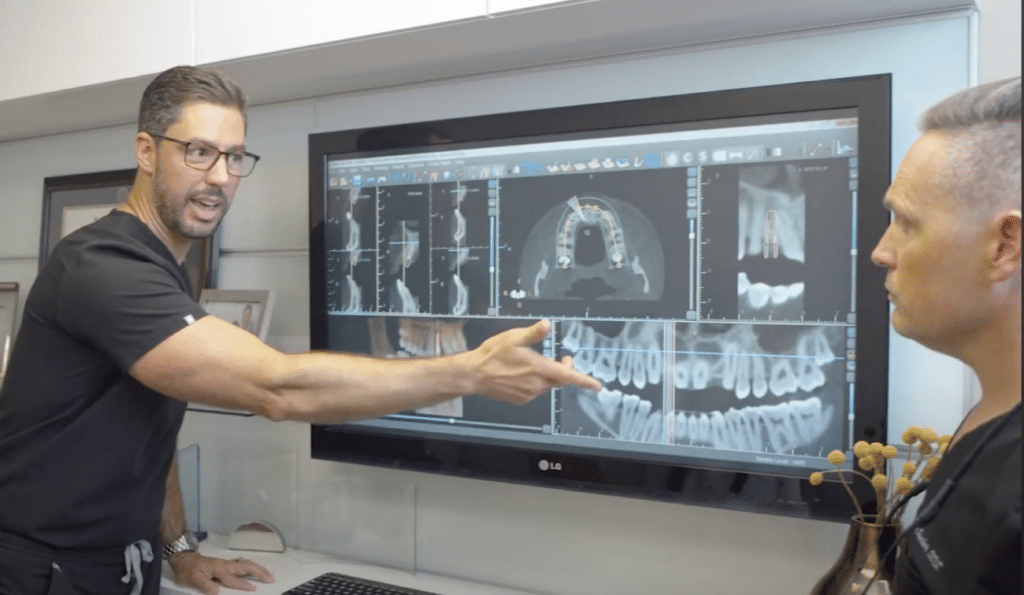
If you’re missing back teeth and wondering whether two implants could work instead of three, the answer depends on the span length and your bone density. Dr. Reichley evaluates this with 3D imaging. He can see exactly how much bone you have and where the implants need to go to handle the load.
Four Implants: Replacing an Entire Arch (All-on-4)
This is where the conversation gets interesting for patients missing most or all their teeth. All-on-4 uses four implants to support a full arch of teeth, either upper or lower. Surgeons place the implants strategically: two straight implants in the front of the jaw and two angled implants toward the back.
The angled implants are the key. They let the surgeon avoid the upper jaw’s sinuses and the lower jaw’s nerve canal. So, patients told they don’t have enough bone for implants can still qualify for All-on-4.
The result is a full arch of fixed teeth that you can’t remove. They look and function like natural teeth, and they’re supported by just four implants per arch.
Dr. Reichley places the implants, and Dr. Sinclair designs the final restoration. Because they work together in the same office, they coordinate planning from day one. The implants go in at angles that make sense for the final teeth, not just for the surgery. That distinction matters for how your smile looks when everything is finished.
Six Implants: More Support for Complex Cases
Six implants per arch provide more support than four. We recommend this configuration for patients with higher bite forces, more available bone volume, or who want maximum stability in their full-arch restoration.
We distribute the implants across the arch to share the load. The final restoration is a fixed bridge or a hybrid denture that’s screwed into place. You don’t take it out at night. You brush and floss around it like you would with natural teeth.
Six implants aren’t necessary for everyone, because many patients do just as well with four. But for patients who grind their teeth, have a heavier bite, or want the most durable solution possible, six implants provide extra security.
Dr. Reichley and Dr. Sinclair decide with the patient whether four or six is right. They base the decision on imaging, bite analysis, and a conversation about what matters most to you. There’s no one-size-fits-all answer.
What About One Implant Per Tooth?
Some patients ask why they can’t just get one implant for every missing tooth. It seems simpler, right? It’s not simpler, and it’s often not better.
More implants mean more surgery, longer healing time, and higher costs. In many cases, it’s unnecessary. The bone between your missing teeth may not support an implant in every position. Placing too many implants in a small area can compromise the blood supply to the bone and increase the risk of complications.
The configurations above work. They’re based on decades of clinical evidence about how implants integrate and how restorations function under real chewing forces. The goal isn’t to place the maximum number of implants. It’s to place the right number in the right positions to support the restoration you need.
At Coastal Cosmetic & Implant Dentistry, we plan every implant case with 3D imaging, digital bite analysis, and a clear picture of what the final restoration will look like. Dr. Reichley’s Fellowship in the International Congress of Oral Implantologists reflects training in complex implant cases, and Dr. Sinclair’s AACD Accreditation reflects a commitment to making sure the final result looks as good as it functions.
If you’re missing multiple teeth and aren’t sure which configuration makes sense for you, we’d be glad to walk you through it. Call us at 757-656-6368 or request an appointment online. We’ll show you your imaging, explain your options, and help you understand what’s actually happening in your jaw.
Learn more about our implant dentistry:
- All-On-Four Implants
- Teeth-In-A-Day
- Benefits of All-On-Four Implants
- Cost of Dental Implants
- Dental Implants Under One Roof
- Dental Implants vs Dentures
- Multiple Dental Implants
- Dental Implant FAQs
- All-On-Four Dental Implants Suffolk, VA
- Dental Implants Chesapeake, VA
- All-on-4 Dental Implants Norfolk, VA
- All-On-Four Dental Implants Chesapeake, VA
- Dental Implants Norfolk, VA