
You’ve done your research and sat through the consultation. You’ve seen the imaging and heard the plan of four implants for a full arch, with a timeline that finally feels manageable. Still, that quiet question lingers: what if one of them doesn’t work?
It’s a smart question. Implant failure is rare, but possible. If you’re about to invest significant time and money in a full-arch restoration, you deserve to know what happens if the plan doesn’t go perfectly.
Let’s talk about what implant failure actually looks like, how often it happens with four-implant configurations, and how a well-prepared practice handles it.
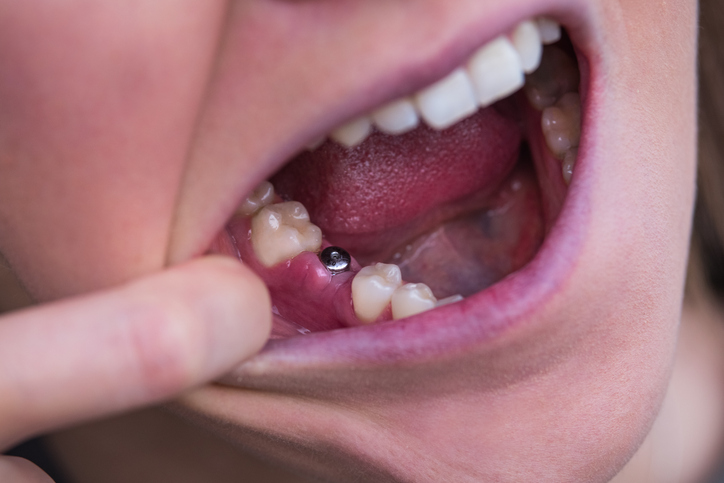
What “Failure to Integrate” Actually Means
When a dentist places a dental implant, it doesn’t immediately become part of your jaw. The titanium post sits in the bone, and over the next few months, your bone cells grow onto and into the implant surface. Called osseointegration, it’s what makes the implant stable enough to support a tooth or a full arch.
Failure to integrate means that fusion didn’t happen, or didn’t happen completely. The implant didn’t anchor in the bone as it needed to. In some cases, the implant becomes mobile. In others, it stays in place but lacks the stability needed to support the final restoration.
Implant failure falls into two broad categories. Early failure happens before the implant has fully integrated, usually within the first few months. Late failure happens after integration because of infection or other long-term issues. You’re asking about the first kind: early failure during healing.
How Often Does It Actually Happen?
The short answer is: not often.
Research on full-arch implant configurations shows high survival rates. A large retrospective study of implant-supported full-arch rehabilitations using four to six implants reported a 4.52 percent failure rate, with cumulative implant-level survival of 91.9 percent over a one- to seven-year follow-up. Another study of All-on-4 cases found an overall implant survival rate of 94.8 percent over a mean follow-up of about 3.6 years.
Those numbers are encouraging, but they’re not zero. When you’re the patient sitting in the chair, the statistical probability matters less than what happens next.
The risk factors that increase the chance of early failure include smoking, uncontrolled diabetes, poor bone quality, and inadequate planning or placement. This is why Dr. Reichley uses 3D imaging to evaluate bone density and volume before surgery. He also asks about your health history and habits. Those factors don’t disqualify you from implants, but inform the plan.
What You’d Actually Notice If Something Goes Wrong
Early implant failure doesn’t always announce itself dramatically. Sometimes the first sign is that something feels off. You might notice the temporary restoration feels loose, or a dull ache that doesn’t fade as it should. You might see swelling or redness around an implant site. Or you might feel nothing at all, and the failure is discovered at a follow-up appointment when the dentist checks integration.
Signs to watch for include:
- Pain that worsens instead of improves
- Mobility of the temporary teeth
- Swelling that persists or returns
- Any discharge or unusual taste near an implant site
None of these automatically mean failure, but they’re worth a phone call.
At Coastal Cosmetic & Implant Dentistry, you’re not calling a separate surgical office and then a separate restorative office. You’re calling the team that placed the implants and planned the final teeth. That matters when something feels wrong, because the people who answer the phone already know your case.
What the Practice Does If One Implant Fails
Here’s where the “under one roof” approach becomes more than a convenience.
If one implant in a four-implant configuration fails to integrate, the first step is to assess the situation. Dr. Reichley will examine the site, take imaging, and determine what happened. Was the bone quality different than expected, was there an infection, or was there excessive force on that implant during healing?
Sometimes the solution is straightforward: remove the failed implant, let the site heal, and place a new implant. In some cases, we add a bone graft to improve the site before replacement. In other cases, the team can adjust the configuration. The remaining three implants may be sufficient to support the restoration, or the team may place an additional implant in a different position.
The key is that the same team that planned the original case makes the decision. No waiting for records to transfer, or uncertainty about who’s responsible for what. Dr. Reichley handles the surgical side, Dr. Sinclair has already planned the final restoration, and they adjust the plan together.
Research on risk factors for full-arch implant failure found that bone grafting materials and the absence of a night guard were among the independent risk factors for implant failure before definitive restoration. That’s useful information for planning. If you grind your teeth, a night guard isn’t optional. If you need bone grafting, it’s not an upsell. A team familiar with your case can address these details proactively.
What About the Rest of Your Teeth?
If one implant fails, the others usually don’t. The failure is typically localized to that site and related to conditions there. The remaining implants continue to integrate normally.
This is why the four-implant configuration is resilient. It’s designed with redundancy. If one implant needs replacement, the overall restoration plan can continue with little disruption. The temporary teeth may need adjustment or replacement, but the long-term outcome doesn’t have to change.
What matters most is reporting concerns early. You can sometimes save a failing implant if you catch the problem before the integration is completely compromised. Waiting to see if it gets better on its own consistently makes the situation worse.
Questions to Ask Before You Commit
If you’re considering a four-implant restoration in Virginia Beach, ask your dentist about their implant-failure protocol. Not every practice has a clear answer. The answer tells you a lot about how they handle complications.
Ask who monitors integration during healing and what happens after hours if you notice something wrong. Ask whether the practice has a plan for replacing a failed implant and whether there are additional costs. Ask how many four-implant cases they’ve done, and what their personal failure rate is.
Dr. Reichley’s training includes Fellowship status with the International Congress of Oral Implantologists, reflecting expertise in implant surgery beyond basic certification. Dr. Sinclair’s AACD Accreditation reflects a commitment to the restorative side of the equation. Together, they’ve built a workflow that anticipates complications rather than reacting to them.
Call Coastal Cosmetic & Implant Dentistry at 757-656-6368 or request an appointment online. We’ll show you the imaging, explain the plan, and answer the question you’re probably too polite to ask out loud.
Learn more about our implant dentistry:
- All-On-Four Dental Implants
- Teeth-In-A-Day
- Benefits of All-On-Four Implants
- Cost of Dental Implants
- Dental Implants Under One Roof
- Dental Implants vs Dentures
- Multiple Dental Implants
- Dental Implant FAQs
- All-On-Four Dental Implants Suffolk, VA
- Dental Implants Chesapeake, VA
- All-on-4 Dental Implants Norfolk, VA
- All-On-Four Dental Implants Chesapeake, VA
- Dental Implants Norfolk, VA