If you have lost most or all of your teeth, you have probably wondered which implant option is best for you. Two of the most common full-arch solutions are All-on-4 and All-on-6. While they sound similar, they serve different needs. At Coastal Cosmetic & Implant Dentistry in Virginia Beach, Dr. Cappy Sinclair and Dr. Mark Reichley help patients understand these options every day.
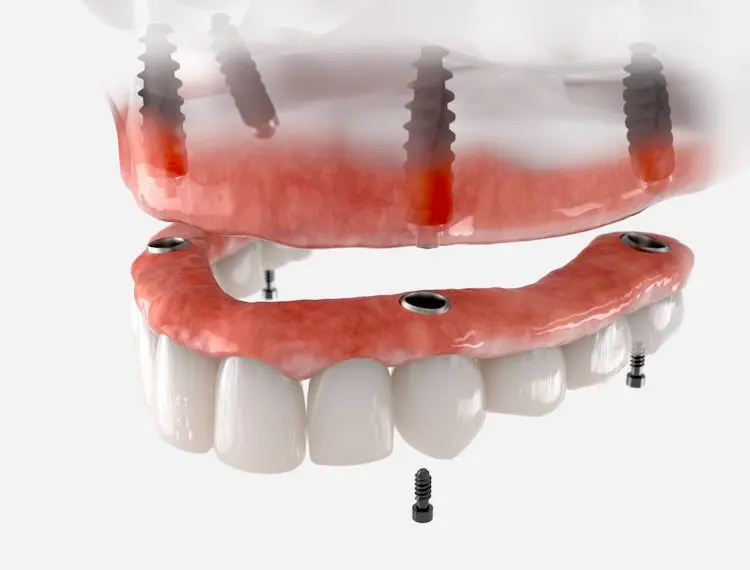
What Are All-on-4 and All-on-6?
Both options replace an entire arch of teeth with a fixed bridge anchored by dental implants. The main difference is how many implants support the bridge.
All-on-4 uses four strategically placed implants. Two of them go in the front of your jaw. The other two are placed at an angle toward the back. This angled placement helps the implants grab onto denser bone, even if you have lost bone volume over time.
All-on-6 uses six implants. Four are placed in the front and middle of your jaw. Two additional implants go toward the back. This gives the bridge more support points, which can spread chewing forces more evenly.
Neither option is universally better. Your dentist in Virginia Beach will recommend the option that fits your anatomy, bite, and long-term goals.
The Bone Factor: Why It Matters
The most important factor in this decision is the quality and quantity of bone in your jaw.
When you lose teeth, your jawbone gradually shrinks. This is called bone resorption. The longer your teeth are missing, the less bone you have to work with.
The All-on-4 dental implant procedure is designed for people with reduced bone volume. The tilted-back implants anchor into the front part of your jaw, which is usually denser. Because of this design, many All-on-4 patients can avoid bone grafting entirely.
All-on-6 requires more bone. The extra implants need space to be placed properly. If you don’t have enough bone, your dentist may recommend bone grafting or a sinus lift before surgery. This adds time and cost to your treatment.
Upper Jaw vs. Lower Jaw
The location of your missing teeth also matters.
The lower jaw has denser bone. All-on-4 usually works very well in the lower jaw because the bone is strong enough to support the four implants.
The upper jaw is different. The bone is softer and less dense. The sinus cavities also limit how much bone is available in the back of the upper jaw. For this reason, many specialists prefer All-on-6 for the upper arch. The extra implants give the bridge more stability in softer bone.
The Redundancy Factor
This is one point dentists often don’t discuss enough. Implants can fail. The most common reasons are infection, peri-implantitis, or failure to integrate with the bone.
If you have All-on-4 and one implant fails, your bridge loses 25% of its support. That can make the whole bridge unstable. You may need to replace it completely.
If you have All-on-6 and one implant fails, you still have five implants supporting the bridge. The bridge usually survives. This “redundancy” is a key reason some patients choose All-on-6 even when their bone is adequate for All-on-4.
One dental specialist put it this way: All-on-6 is like flying a plane with six engines. You can lose one and still fly. All-on-4 is like a table with four legs; if you lose one, the whole thing wobbles.
How Dr. Sinclair and Dr. Reichley Make the Decision
At Coastal Cosmetic & Implant Dentistry, your treatment starts with a thorough evaluation. Dr. Sinclair and Dr. Reichley use 3D imaging and CBCT scans to map your bone in detail. These scans show bone height, bone width, and the location of important structures like nerves and sinus cavities.
They also evaluate your bite, your medical history, and your lifestyle. Conditions like diabetes, smoking, and teeth grinding can all affect how well your implants heal.
Doctors don’t just count implants. They consider your specific anatomy and long-term needs. Their goal is to provide a stable, lasting restoration that will serve you for decades.
Recovery and Maintenance
Both procedures follow a similar recovery timeline.
On the day of surgery, you will receive a temporary set of teeth. This means you leave the office with a functional smile. You won’t have to wait months without teeth.
The healing phase takes about three to six months. During this time, your implants will fuse with your jawbone. This process is called osseointegration.
You will need to stick to a soft diet during the first few months. You will also need to avoid smoking and keep your mouth very clean.
Once the healing is complete, you will return to the office for your final restoration. The permanent teeth are stronger, more refined, and more natural-looking than the temporary set.
Which Option Is Right for You?
If you have significant bone loss in your jaw, All-on-4 is the better choice. It allows you to avoid bone grafting. It’s also less expensive because you place only four implants.
If you have enough bone and want the added security of redundancy, All-on-6 may be the right call. It offers more stability and a wider safety margin if something goes wrong. It’s especially recommended for the upper jaw, where the bone is softer.
The most important step is getting a professional evaluation. The right choice depends on your specific anatomy, your budget, and your long-term goals.
Ready to Restore Your Smile?
If you have been living with missing teeth or uncomfortable dentures, you don’t have to wait any longer. Dr. Cappy Sinclair and Dr. Mark Reichley have the training and experience to guide you through this decision. They are members of the American Academy of Cosmetic Dentistry and the International Congress of Oral Implantologists. They use advanced technology and personalized care to deliver life-changing results.
Contact our Virginia Beach office today at 757-656-6368 or request an appointment online. We proudly serve patients from Virginia Beach, Chesapeake, Norfolk, Suffolk, and all surrounding communities.